

Strategy
KAIO vs. Other AI Tools: What Is the Difference Between an AI Tool and a Customer Acquisition Guidance System?
There are more AI tools than ever. The biggest difference is whether a tool only helps you do more or guides customer acquisition through better decisions.
There are more AI tools than ever.
- Some help write content.
- Some compile reports.
- Some handle analytics.
- Some automate individual marketing or sales tasks.
All of these can be useful. But in many companies, the biggest problem is no longer that AI is not being used. The biggest problem is this: AI helps teams do more, but it does not necessarily help them decide what should be done next. This is exactly what KAIO was built for.
KAIO is not just a single AI tool. It is customer acquisition AI that combines marketing, sales, and business data into one whole. Its purpose is not to produce more disconnected content, reports, or views, but to help understand:
- Where new customers actually come from
- Which actions support growth
- Where marketing should be directed next
- How customer acquisition can be developed more profitably
In this article, we compare KAIO with other AI tools at a general level and explain when a standalone AI tool is enough and when a broader guidance model is needed.
What is a typical AI tool?
A typical AI tool usually means software that helps perform one individual task faster or more efficiently. For example, it can:
- Write draft copy
- Analyse data
- Generate ad ideas
- Create summaries
- Automate reporting
The benefit of these tools is clear: they save time and improve the efficiency of individual work stages. But their limitation is often the same. They are usually task-specific. They do not necessarily know what matters most for the company business. They do not always connect marketing, sales, website, and customer journey data into one whole. They also may not be able to say which action has the greatest impact on revenue.
A typical AI tool can answer the question: "How can this be done faster?" But it does not always answer: "What should we do next to get more of the right customers?"
What makes KAIO different?
KAIO starts from a different question. Instead of focusing only on automating an individual task, KAIO looks at customer acquisition as a whole. KAIO combines data from different sources and helps identify what in marketing and sales actually affects growth. In practice, KAIO helps answer questions such as:
- Where do leads come from?
- Which channels bring the highest-quality contacts?
- Where should budget be allocated?
- Which content or campaign supports sales?
- Where does the customer journey leak?
- Which actions should be prioritised next?
- How does marketing impact the business?
This makes KAIO more than an AI tool. KAIO works as a customer acquisition guidance system. Its goal is not only to speed up activity, but to improve decision-making.
A typical AI tool optimises tasks — KAIO optimises the whole
One key difference is perspective. Many AI tools are very good at individual things. They can help write better ad copy, create a faster report, or find new content ideas. But customer acquisition results do not come from one task. They come from the whole:
- Target audience
- Message
- Channels
- Content
- Advertising
- Website
- Conversion path
- Sales follow-up
- Data interpretation
- Continuous optimisation
If these are viewed as separate parts, a company can do many things that look right while growth still fails to materialise. KAIO has a more holistic perspective. It does not only ask: "How can this campaign be improved?" It asks: "Which part of customer acquisition is limiting growth right now?"
Example: how the difference appears in practice
Imagine a company doing digital marketing across several channels. It uses search advertising, social media advertising, content marketing, website analytics, and a CRM system. There is plenty of data, but the full picture is missing.
A typical AI tool can help with things such as:
- Writing ad copy
- Creating a campaign report
- Generating blog ideas
- Summarising analytics data
- Suggesting new keywords
These are useful things. But company leadership wants to know something more important: which of these actions actually brings customers?
A single AI tool is not always enough for that. KAIO’s role is to connect the whole and show where the greatest growth potential is. For example, it can help identify that:
- One channel brings a lot of traffic but few qualified leads
- Another channel brings less traffic but better sales opportunities
- The website conversion path loses interest too early
- Marketing and sales data are not used together in decision-making
- Reporting shows results but does not guide action
At that point, the question is no longer just how marketing is executed. The question is how customer acquisition is managed.
Why reporting alone is not enough
Many AI tools can produce reports and summaries. That is a good start, but reporting alone does not change results. A report usually tells what happened. KAIO’s goal is to help understand what should be done next.
If a report shows that website traffic increased, the next question is:
- Did the number of leads also increase?
- Did lead quality improve?
- Did the effect show up in sales?
- Was the traffic from the right target audience?
- Should the same activity continue or change?
Without this interpretation, reporting easily remains passive. KAIO’s perspective is guiding: data is not collected just to be viewed, but to support decision-making.
When is a typical AI tool enough?
A typical AI tool can be fully sufficient when the goal is to make one work stage more efficient. It works well, for example, in situations where you want to:
- Write content faster
- Draft ads
- Summarise meetings
- Analyse an individual file
- Automate recurring tasks
- Get campaign ideas
In these cases, a separate AI tool can be a fast and cost-effective solution. But if the problem is broader, such as weak visibility, unclear ROI, scattered data, or difficulty knowing what actually works in marketing, a more holistic model is needed.
When is KAIO the right solution?
KAIO is especially useful for companies that want to develop customer acquisition systematically and from a business perspective. KAIO is useful if the company recognizes challenges such as:
- Marketing data is scattered across systems
- Too many decisions are based on assumptions
- Marketing ROI is difficult to prove
- Sales and marketing do not look at the same data
- Leads are generated, but quality varies
- Reporting takes a lot of time
- Campaigns are executed, but the overall impact remains unclear
- Growth is wanted, but it is unclear where to invest first
In these situations, a single AI tool can help teams do things faster. KAIO helps decide which things are worth doing.
KAIO does not replace people; it improves decision-making
AI is often discussed as if technology solves everything automatically. In reality, the best results are created when AI and expertise work together. KAIO’s role is not to remove people from decision-making. Its role is to bring a better full picture to support decisions.
AI can identify data-based observations, but business understanding, strategic choices, and quality of execution remain decisive. That is why KAIO’s value comes from a combination of:
- Data
- AI
- Business understanding
- Marketing and sales expertise
- Continuous optimisation
This makes KAIO a practical solution for companies that do not want only more tools, but better guidance for growth.
Summary: the biggest difference is decision-making
Typical AI tools help make individual tasks more efficient. KAIO helps understand what should be done next in customer acquisition. The difference can be summarized like this:
- A typical AI tool makes doing more efficient.
- KAIO guides growth.
Both have their place. If you need faster content, reports, or ideas, an individual AI tool can be a good solution. But if the goal is to build a more predictable, measurable, and profitable customer acquisition model, more than a single tool is needed. You need a system that combines data, identifies what matters, and helps make better decisions. That is exactly what KAIO was built for.
Want to find out where your biggest growth potential is?
A KAIO analysis helps identify how your company customer acquisition currently works and where the biggest opportunity to improve results lies. In the analysis, you will see, among other things:
- Where customer acquisition growth potential is
- Which areas limit results
- Where competitors may be ahead
- What changes could improve marketing impact
Take a free KAIO analysis or book a demo, and we will look at how customer acquisition can be guided toward better results.
Continue reading
Strategy
Google is making sources more visible in AI search – what does the change mean for businesses?
Google is adding more in-text links to AI answers and improving how sources are presented. We break down what the change means for business visibility, traffic and customer acquisition.
Strategy
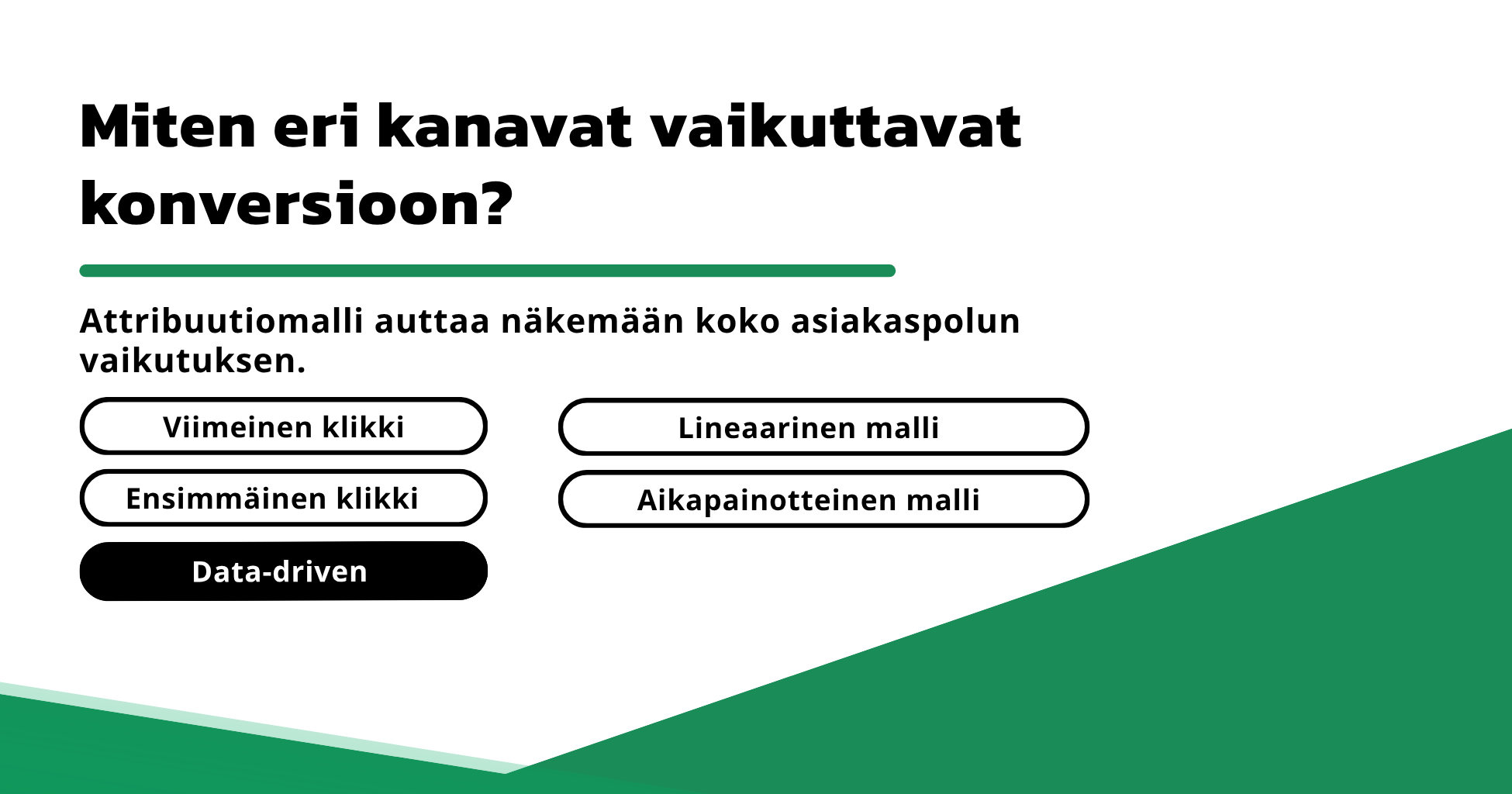
Attribution modeling in B2B marketing – identify how channels influence conversions
B2B buying journeys rarely resolve through one click. Attribution helps reveal which touchpoints created demand and which converted it.
Strategy
Google AI Mode and ChatGPT Already Answer Your Customers’ Questions. Is Your Company Among the Recommendations?
Traditional search engine optimization is no longer enough. Generative Engine Optimization (GEO) is your new way to win B2B customers before they even reach your website.

Ready to Outpace the Market?
KAIO helps guide sales and marketing with data toward better results.