

Strategy
Google is making sources more visible in AI search – what does the change mean for businesses?
Google is adding more in-text links to AI answers and improving how sources are presented. We break down what the change means for business visibility, traffic and customer acquisition.
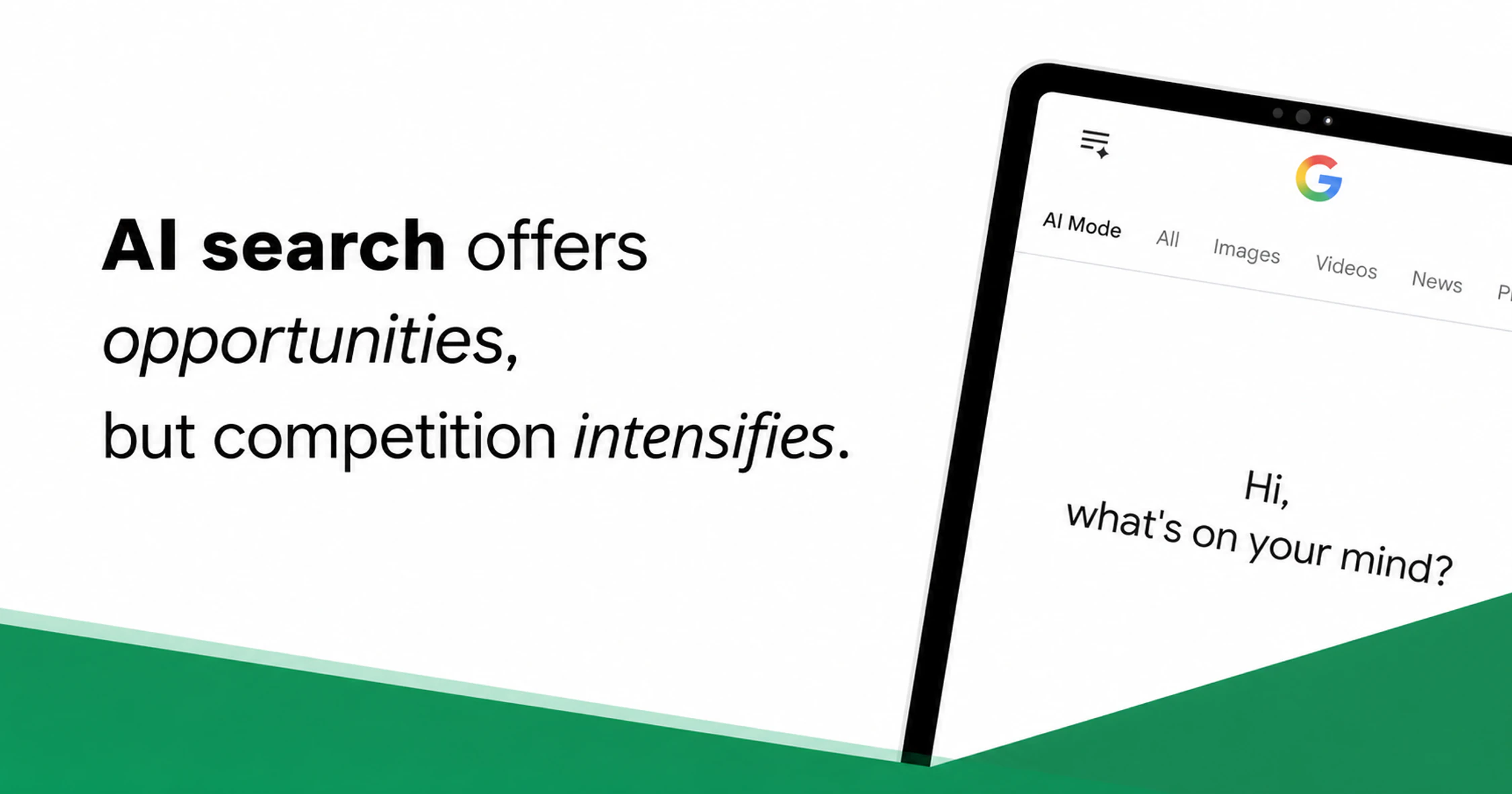
Google is refining how sources appear in AI Mode and AI Overviews answers. More in-text links can be added alongside AI-generated summaries, the way sources are presented is being improved, and users are offered new routes to the original content.
For businesses, the direction is fundamentally positive. The more prominently sources are surfaced, the more opportunities high-quality expert content has to earn visibility and website visitors.
More links, however, do not automatically mean that traffic will grow or be distributed evenly across sites.
Google still chooses which sources to show in AI answers, which claims to connect them to and how prominently to present them. At the same time, an AI answer can resolve part of the user’s information need without them visiting a single website. The change may therefore concentrate attention even more strongly on businesses whose content is clear, trustworthy and genuinely useful.
What is Google changing in AI Mode and AI Overviews answers?
Google is continuously developing its AI-based search experience. The availability, appearance and behaviour of individual features may vary by country, language, device, user and search type. Not every feature launched in the US or in English-language search is necessarily available in Finland right away.
The general direction of development is, however, clear: Google aims to connect AI-generated answers more visibly than before to the web sources that support them.
1. More in-text links in AI answers
In AI Mode and AI Overviews answers, sources can be shown directly alongside the text that uses them. This makes it easier for the user to assess what a particular claim is based on and where to read more about the topic.
An in-text link is more valuable to a business than an inconspicuous mention in a separate source list, because it connects the content directly to the user’s question. The position of the link can significantly affect whether the user notices the source and feels that visiting the site is worthwhile.
From a business perspective, the goal is therefore not merely to be mentioned in an AI answer. What matters more is becoming a source at exactly the point where the user needs additional information, evidence or help to support their decision.
2. Source previews and presentation are being developed
Google may show a source’s title, publisher, a short description or another preview before the user moves to the website. The exact implementation varies by search experience and interface.
The preview influences the click decision. Simply being included among the sources is not enough if the user does not understand:
- who published the content
- which question the content answers
- why the source can be trusted
- what added value the original page offers beyond the AI answer.
The title, publisher and content promise must form a credible whole already in the search result. If the AI answer provides the basics, the original content has to offer the next step: deeper analysis, practical guidance, a comparison, a calculation, research findings or a real-world example.
3. Recognisability of the publisher and expert becomes more important
In AI search, the value of a source is not based only on the content of an individual text. The publisher’s reputation, topic-specific expertise and other evidence visible online can also affect how credible the content appears.
This strengthens the position of recognisable businesses and experts. Generic mass-produced content finds it harder to stand out from content backed by:
- a named expert
- described competence and experience
- proprietary data or practical observations
- a consistent body of content
- transparent sources and update information.
The connection between the brand, its experts and its content should be easy to understand for both humans and search engines.
4. The search journey becomes more conversational
AI Mode can suggest follow-up questions and help the user refine their information need. In that case the search does not necessarily end with a single question and answer, but progresses step by step towards a comparison, a decision or a contact.
A business should therefore not build its content strategy solely around individual keywords. Content should answer the interconnected questions that arise during the same buying journey.
The journey of a B2B buyer investigating marketing results might progress like this:
- How is marketing ROI calculated?
- Which costs need to be included in the calculation?
- How do you separate marketing’s impact from other factors affecting sales?
- How do you combine sales and marketing data?
- What kind of attribution model suits a long B2B buying journey?
- How do you report the impact of different channels on leads and deals?
- Does implementation require a new tool, an integration or a change in operating model?
A business can build a credible expert position across several stages of the buying journey if its content forms a comprehensive and consistent whole.
Why don’t more links guarantee evenly distributed traffic?
More visible source references increase the potential routes to websites, but they do not remove Google’s role as the selector and presenter of information.
An AI Mode or AI Overviews answer may use several sources, but not all sources receive equal attention. One link may appear directly alongside a key claim, another in a separate source card and a third only behind an expandable element.
Traffic is affected by factors such as:
- the position of the link in the AI answer
- its connection to the user’s original question
- the source’s title and preview
- the publisher’s reputation
- the user’s need for information deeper than the AI answer
- how comprehensively the answer resolves the information need without a click.
AI search can therefore increase the number of so-called zero-click searches. The user gets the answer directly from the search service and does not necessarily visit the original pages, even though their information was used to form the answer.
On the other hand, a user who clicks through to a source after an AI answer may be further along in their information search than usual. The volume of traffic may then not grow in the same proportion as visibility, but the visitor’s interest and commercial significance may be greater.
Which businesses and content can benefit?
The best opportunities lie with businesses that can provide clear, well-justified answers to their target audience’s real questions.
Benefiting does not depend only on the size of the business or the reputation of the domain. Even a smaller expert business can gain visibility on a narrowly defined topic if the content is useful, original and credible.
Content that performs well in AI search tends to include:
- a direct answer to a precisely defined question
- a clear structure with descriptive subheadings
- understandable definitions and conclusions
- proprietary data, research or practical observations
- concrete examples and customer cases
- a named author or expert
- sources, an update date and the necessary background
- a justified reason to move to the original page.
Particularly valuable is content that cannot easily be replaced by a generic AI summary. This includes, for example, original research, calculators, comparisons, methodology descriptions, customer-specific observations and practical implementations.
What does the change mean for managing customer acquisition?
AI search increases the importance of high-quality expert content, but at the same time it makes measuring customer journeys more demanding than before.
GEO, or generative engine optimisation, does not replace search engine optimisation. It broadens the perspective on how a business’s information is found, understood, summarised and presented in generative search experiences.
AI search should therefore not be managed as a standalone SEO project. The full picture only emerges when visibility is combined with:
- content usage
- website behaviour
- identified leads
- sales opportunities
- realised revenue.
KAIO helps businesses combine marketing and sales data into an understandable whole. The goal is to identify which actions build demand, where high-quality leads come from and where marketing resources should be directed next.
Do you know which visibility actually brings you customers?
Find out where the greatest growth potential in your customer acquisition lies, what your current data reveals and which actions are worth prioritising next.
Continue reading
Strategy
Attribution modeling in B2B marketing – identify how channels influence conversions
B2B buying journeys rarely resolve through one click. Attribution helps reveal which touchpoints created demand and which converted it.
Strategy
Google AI Mode and ChatGPT Already Answer Your Customers’ Questions. Is Your Company Among the Recommendations?
Traditional search engine optimization is no longer enough. Generative Engine Optimization (GEO) is your new way to win B2B customers before they even reach your website.

Strategy
KAIO vs. Other AI Tools: What Is the Difference Between an AI Tool and a Customer Acquisition Guidance System?
There are more AI tools than ever. The biggest difference is whether a tool only helps you do more or guides customer acquisition through better decisions.
Ready to Outpace the Market?
KAIO helps guide sales and marketing with data toward better results.