

AI-Guided Growth
How to build a working growth engine for your company
A growth engine brings target audience, value proposition, channels, content, conversions, sales, and metrics into one repeatable model.
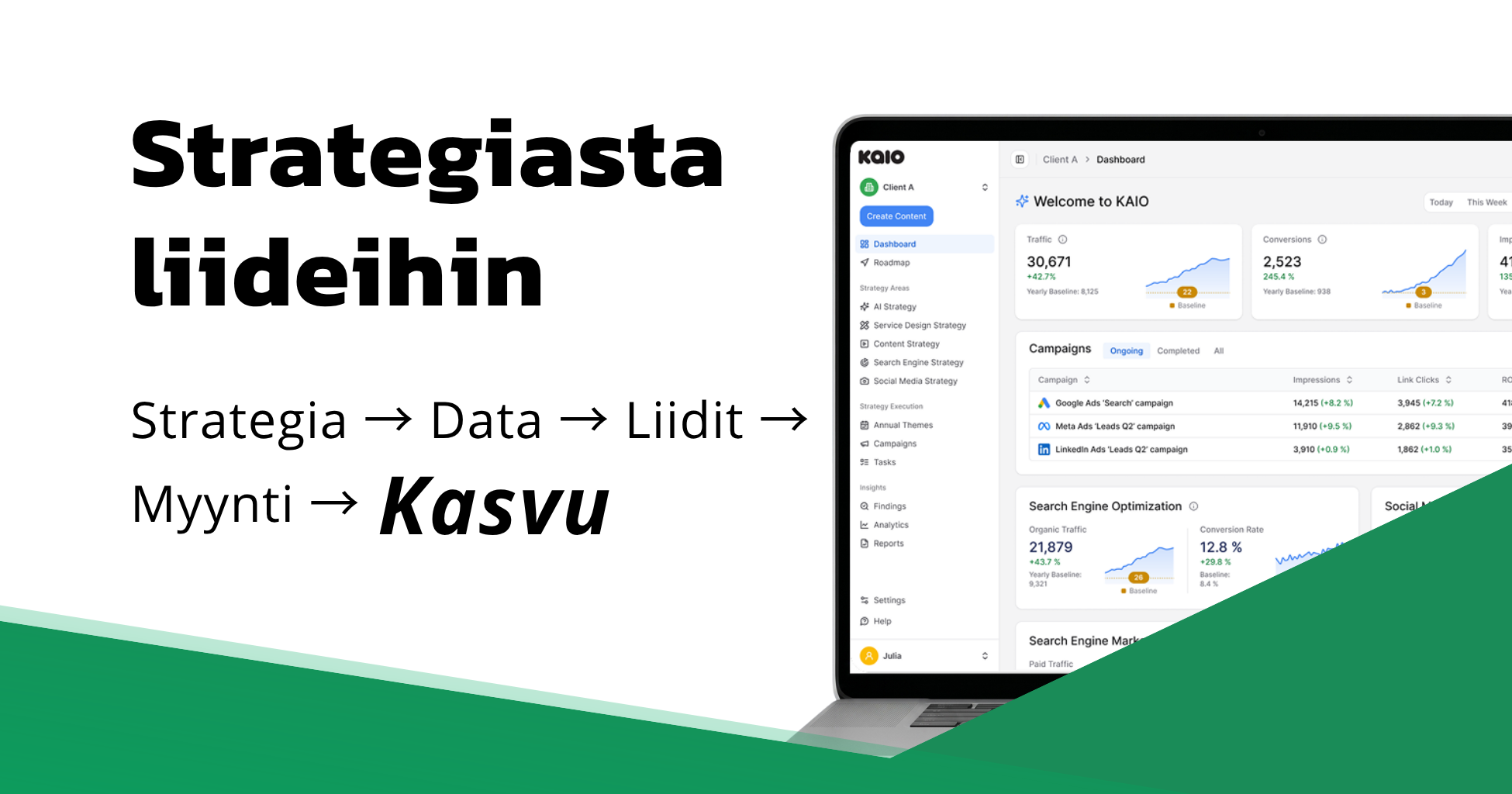
Company growth does not happen by accident or through isolated actions. Predictable and profitable growth requires a clear operating model where strategy, marketing, and sales work toward the same goal. A working growth engine makes this work systematic, repeatable, and data-driven: it helps create high-quality sales opportunities, understand what works in practice, and guide customer acquisition measurably.
A growth engine is not a single marketing campaign, a new social channel, or a separate piece of software. It is a whole that makes customer acquisition more predictable, measurable, and profitable. When the engine is built correctly, you know where to invest, what to improve, and which actions produce the highest-quality enquiries.
Why are individual campaigns not enough?
Many companies try to solve sales challenges by launching new ad campaigns. Although campaigns can create short-term spikes in website traffic or enquiries, they rarely solve the fundamental problem. When the campaign budget ends, the results end too.
The biggest problem with individual campaigns is lack of learning. They do not always build enough understanding of what actually moves the customer forward in the buying journey. Data-driven growth is based on continuity: instead of starting over every time, the customer acquisition model regularly collects observations from website analytics, campaign data, lead forms, and sales feedback. Based on these, work can be improved step by step and investments can be focused where the highest-quality enquiries are created.
What are the parts of a working growth engine?
A sustainable customer acquisition model is built on seven key pillars. When these parts work together, results follow.
1. Target audience
Everything starts with understanding. Who are we selling to? In B2B customer acquisition, you must identify not only ideal customer companies, but also the decision-makers. The narrower and more precisely defined the target audience, the more effectively the whole system works.
2. Value proposition
Which urgent problem do you solve for the customer? The value proposition must be clear and business-oriented. Listing features is not enough; the customer must immediately understand how your service improves their work, saves time, or improves the bottom line.
3. Channels
Where does your target audience spend time and search for information? A working customer acquisition model does not require being present everywhere, but choosing the right channels. Whether through Google searches, expert networks on LinkedIn, or targeted email marketing, channels exist to bring the right eyes to your message.
4. Content
Content guides the customer forward in the buying journey. It teaches the logic of a new category, answers customer questions, and builds trust before the first sales conversation. High-quality content helps the customer recognize their own problem and see your company as the solution.
5. Conversion path
How is interest turned into a concrete lead? Your website should not be just a digital brochure; it should be an active part of the sales engine. Clear calls to action, customer-serving landing pages, and low-threshold contact options ensure that hard-earned traffic is not wasted.
6. Sales process
Marketing-generated leads are worthless if the sales process is not in order. In data-driven customer acquisition, marketing and sales are not separate silos. A defined process from lead to meeting and from meeting to proposal keeps the customer experience seamless and maximizes the likelihood of a deal.
7. Measurement
Without measurement, growth cannot be guided. A well-built measurement model does not focus only on impressions or clicks, but on business-relevant numbers: the quantity and quality of enquiries, channel-level performance, conversion rates, and which leads progress best in sales.
How is customer acquisition led with data?
Once the core parts of customer acquisition are in place, the next task is to lead the whole systematically. This is where many companies stumble: data is available, but it is not necessarily used regularly in decision-making.
Data-driven decision-making can start lightly and practically. Website analytics shows where traffic comes from and which pages create interest. Campaign data shows which channels and messages bring enquiries cost-effectively. Lead form data helps evaluate what kinds of companies and needs sit behind enquiries. Sales feedback shows which leads are truly relevant and progress in conversations.
When these observations are reviewed regularly, customer acquisition can be developed without a heavy systems project. The key is to create a clear reporting rhythm, follow the same metrics consistently, and prioritize work based on what produces the highest-quality enquiries. This allows marketing budget, content work, and sales resources to be directed where they have the greatest impact.
Want to see where the biggest bottleneck in your growth engine is?
Continue reading
AI-Guided Growth
Data-driven decision-making in marketing – how do you decide what to do next?
Turn fragmented marketing data into clear priorities: what to stop, what to fix, and what to scale next.

AI-Guided Growth
How a Marketing Manager Justifies the Budget When Results Are Demanded Faster
Defending the marketing budget to leadership requires more than operational metrics. The right data transforms the budget conversation from cost control to investment discussion.
AI-Guided Growth
Speed Is the Advantage in Customer Acquisition - Why the Fastest Learner Wins the Market
In customer acquisition, speed is the advantage: the faster company spots buying signals earlier, fixes waste sooner, and turns what works into action before competitors.

Ready to Outpace the Market?
KAIO helps guide sales and marketing with data toward better results.